

 Refresh
Nature cover illustration for a CERN article
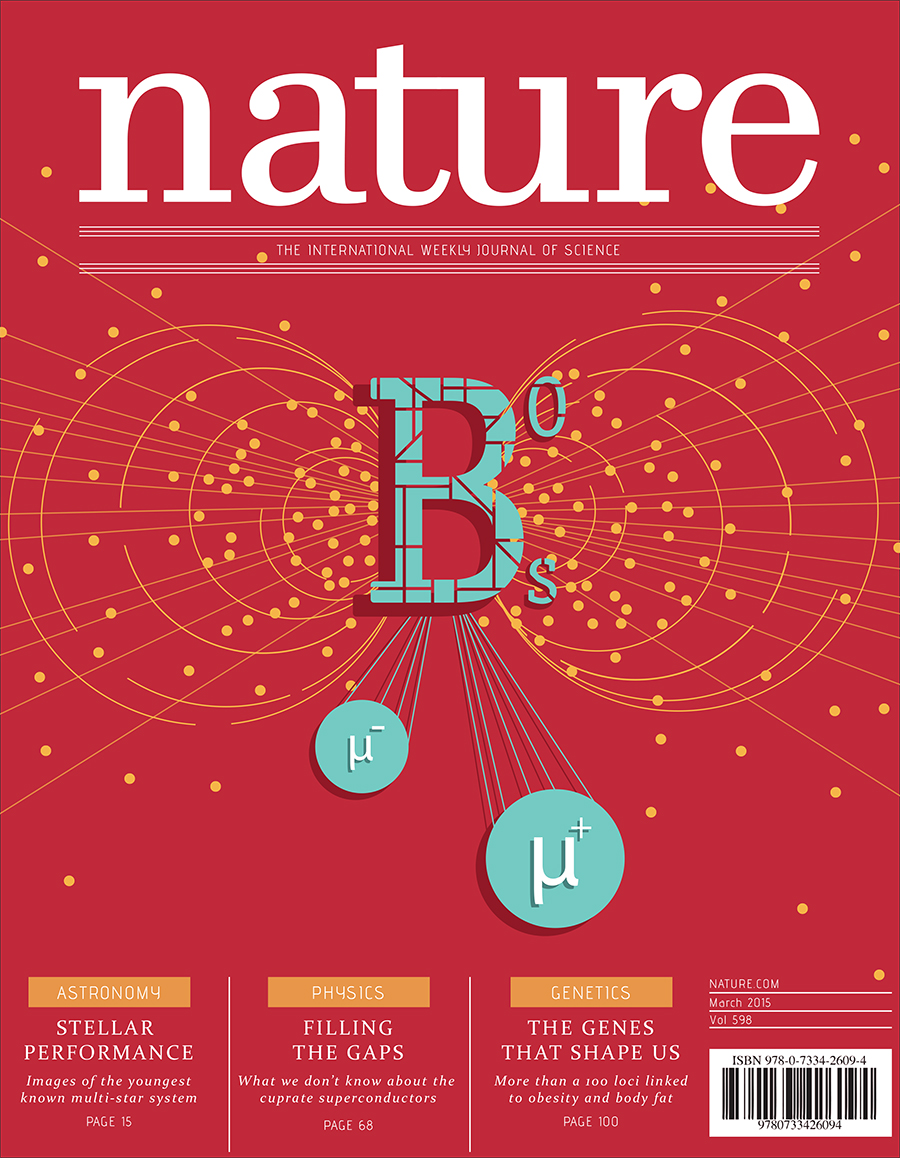
Want to win a job like this?
This customer received 10 magazine designs from 3 designers. They chose this magazine design from SigridS as the winning design.
Join for free Find Design Jobs
-
 €120
€120
-
 10 designs
-
 3 designers
Magazine Design Brief
We are looking for a cover illustration for an important particle physics article about a discovery of rare decay process at two CERN experiments. The article will be soon published in one of the most popular science magazine - Nature.
The illustration should catch the readers imagination about the nature, the universe, the subatomic quantum scale physics, the extremely rare processes studied in proton collision at CERN; it should relate to our article about a discovery of one of the rarest decays ever observed. The discovery is of great importance to the particles physics and it shows we are able to predict extremely subtle quantum effects to great precision.
The article itself: http://arxiv.org/abs/1411.4413
We are allowed to submit several designs along with our article. According to Nature editors, the competition between accepted articles for the cover illustration is intense and the cover illustration will be selected more for its aesthetic appeal than for its scientific content.
Previous Nature cover illustrations: https://www.pinterest.com/naturepubgrp/nature-covers/

Updates
Project Deadline Extended
Reason: Waiting for secondary designs from a few designers.
Added Thursday, March 26, 2015
Look and feel
Each slider illustrates characteristics of the customer's brand and the style your logo design should communicate.
Elegant
Bold
Playful
Serious
Traditional
Modern
Personable
Professional
Feminine
Masculine
Colorful
Conservative
Economical
Upmarket
Requirements
Nice to have
- It would be nice to have:
- (i) an indication of a decay of a very fast moving particle into two smaller (positively and negatively charged) particles. Something in the lines of: http://scitechdaily.com/babar-data-suggests-possible-flaws-in-the-standard-model/
- (ii) a suggestion to messy proton-proton collisions which produce many particles and could be though of as: http://www.foxnews.com/science/2013/04/24/cern-scientists-find-asymmetry-in-particle-decay/